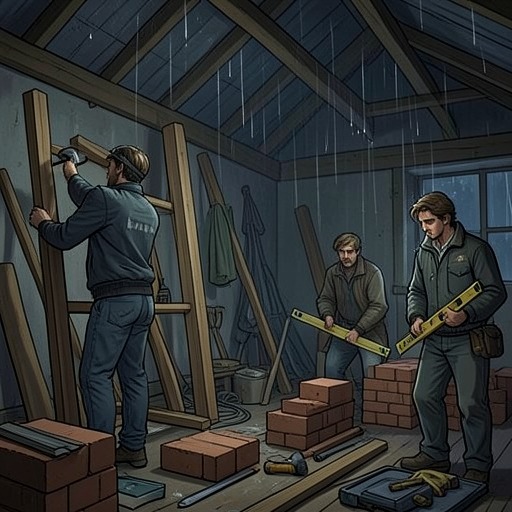
“Walls holding, roof sound”
The Wife He Never Wanted: A Marriage-In-Crisis Billionaire Romance (Second Chance Billionaires)“Walls holding, roof sound” is a recurring expression in the story that joins physical safety to relational trust. It begins as an architectural concern at Harbor Street Shelter, where a failing roof threatens animals already living in an inadequate building, and ends as a quiet measure of the rebuilt shelter and Paige Templeton and Maddox Caldwell’s repaired marriage. The phrase matters because it describes more than successful construction: it names a foundation that can bear weight without collapsing under the first serious storm.
From Warning Sign to Crisis
Maddox Caldwell first encounters the idea through professional perception rather than sentiment. After spending four shifts sitting quietly near Skipper, he looks up from the dog’s run and notices a sagging roofline, a dip in the fascia, and a stain running down the block where water has been entering for some time. His experience on job sites tells him that these are not cosmetic defects. They indicate a failing load path, a structural problem moving toward seriousness.
The discovery creates a sharp contrast between the parts of his life he can and cannot control. Maddox understands that the marriage remains beyond his power to repair by force, but the roof presents a danger that can be identified and acted upon. He reports the compromised corner to Claire and recommends an updated assessment. The warning is real, yet the shelter’s limited time and funds prevent the reassessment from being completed before the storm exposes the full cost of deferred deterioration.
When the east runs collapse, Claire tells Paige that the corner Maddox flagged has failed and taken part of the intact wing with it. Water pours into the main kennel room, while thirty animals must be moved within an hour and every emergency boarding option is full. The roof’s failure therefore turns the expression’s implied promise inside out: the walls no longer provide refuge, and the roof no longer protects the vulnerable beings inside. The disaster is not presented as an isolated act of weather, but as a storm striking a structure already weakened by long-term neglect and insufficient resources.
Emergency Shelter and Unobserved Labor
Paige calls Maddox not as a gesture of forgiveness but because she needs the one person who can provide a sound roof immediately. She asks for the unfinished apartments at Caldwell Development, an empty building whose roof still holds, and explains that thirty animals have nowhere to go. Maddox gives her the development without hesitation and begins organizing help before she can finish explaining the situation.
At Harbor Street, the rescue effort is bodily and chaotic. Claire and volunteers carry crates through ankle-deep runoff while rain enters through the collapsed east end. Paige helps move frightened dogs, yowling cats, and whimpering puppies; she prevents a border collie from bolting through the open wall, carries a senior cat in a pillowcase when the carriers run out, and holds a flashlight in her teeth while Claire draws a terrified pit bull away from the collapse. The expression’s meaning is temporarily reduced to immediate necessities: the next crate, the next animal, and enough cover to keep the rising water from becoming fatal.
Caldwell trucks arrive with workers in rain gear and a site manager. Maddox is already soaked through, but he does not approach Paige first or turn the emergency into a marital performance. He goes to Claire, who is directing the evacuation, asks what she needs, and performs the requested work. He hauls crates in the rain without attracting attention, and the unfinished development opens its doors twenty minutes later, with utilities operating and heat pushing back the cold.
The temporary refuge changes the expression from a wish into an observable fact. The animals are eventually settled in a dry unfinished lobby among crates, blankets, and the smell of wet animals, while the storm continues to strike the glass outside. Near midnight, Paige sees Maddox holding a shivering terrier mix inside his ruined jacket. Because he is already caring for the dog when she approaches, and because he has worked without asking to be watched or praised, she cannot dismiss his help as a staged campaign. Money has become labor performed in the middle of her flooded world.
Rebuilding Without Taking Control
A week after the storm, the animals are safe but homeless, and Harbor Street cannot reopen in its old building. The insurance coverage is partial: water damage is covered, but the preexisting deterioration at the flagged corner falls under an exclusion, while required code upgrades are also excluded. A modern-code rebuild costs more than the shelter has ever possessed, and the old cramped site had never offered the capacity Harbor Street needed even before it became a ruin.
Maddox responds with drawings rather than flowers. He brings preliminary feasibility sketches, three possible sites, zoning and access notes, flood-plain data, and figures supporting a construction commitment backed by Caldwell. Yet the most important document is deliberately unfinished: a program-requirements template with blank fields for intake capacity, an isolation ward, quiet rooms, and community space.
He tells Paige and Claire that he knows buildings but does not know shelters. Claire knows what the shelter needs, including a true quarantine wing with separate air handling and a community room large enough for indoor adoption events. Maddox therefore refuses to draw the next wall until they define every room, run, and function. He will provide the money, land, and crew; Paige and Claire will decide what gets built. The rebuilt roof becomes credible because the people who will live and work beneath it retain authority over its design.
This method reverses Maddox’s former habit of controlling every variable and presenting a finished answer from an elevated position. The blank page is harder for him than a conventional deal because it requires him to surrender the power that once made his solutions resemble acquisitions. The story treats that surrender as a form of labor. The gift is not simply a building; it is a building that Paige is allowed to shape and that Harbor Street can own without becoming an extension of Caldwell’s name.
The Expression as a Measure of Repair
The phrase also becomes a standard for Maddox’s personal change. Paige explains that the deepest wound was not his attachment to expensive furniture after a foster dog came into the house covered in mud. What broke her trust was that he reached first for the upholstery rather than the dog, or for Paige’s happiness in fostering it. That moment taught her that comfort and property ranked above both animal and wife.
Maddox accepts the judgment without defending himself. He says that he cannot undo the earlier choice and can only become the better version now, preferring a muddy dog, a wrecked rug, and Paige beside him on the floor to a perfectly clean house with no one inside it. His comparison makes the expression intimate: a sound house is worthless if it is emotionally empty, while a damaged rug can coexist with a living relationship.
The reconciliation remains conditional rather than purchased. The merger stays dead, and the shelter agreement is written with rules: the land and finished building will be deeded to Harbor Street’s nonprofit, with no Caldwell name attached and no strings extending beyond Maddox’s payment. Paige and Claire retain the right to run it whether or not Paige ever wears Maddox’s ring again. In that arrangement, structural integrity and personal agency become inseparable. Maddox can build the roof, but he cannot buy the marriage back.
Final Meaning at New Harbor Street
The new Harbor Street opens on a Saturday in October. Skipper is the first dog through the door, and Paige has placed his old torn ear in the shelter’s logo, a private memorial known to Paige, Claire, and Maddox. The shelter keeps its original name because Harbor Street has survived two decades and one collapse; its identity is treated as something earned through endurance rather than something that should be replaced by the name of its financier.
The completed building includes the features Claire named at the Templeton kitchen table: separate air handling for the isolation ward, a real quarantine wing, and a community room large enough for indoor adoption events. Families move among animals who now have walls that hold and a roof that does not require anyone to pray when the sky darkens. The phrase has become a material description of a safer institution, but also evidence that reconstruction has improved the shelter rather than merely restored its former inadequacy.
At the opening, Paige crosses the floor to join David Templeton over a drainage plan, with Maddox following and adding himself to the practical discussion. Skipper sleeps in a patch of afternoon sun, his torn ear turned inside out, while the shelter continues operating around him. The final image gathers the expression’s meanings together: the building stands, the animals have refuge, work remains to be done, and the marriage has acquired a foundation sturdy enough to participate in ordinary life. “Walls holding, roof sound” is therefore both a report on the shelter and the story’s clearest test of whether Maddox’s redemption has become durable practice rather than another grand promise.